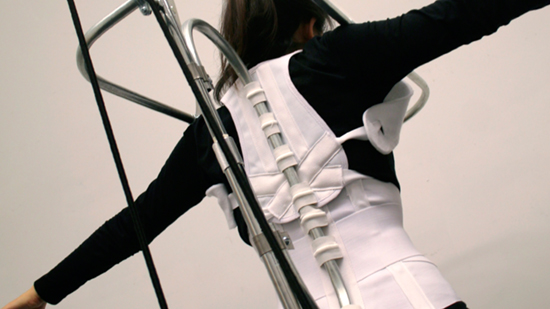
Desirable Posture is a wearable exoskeletal structure developed in response to persistent pain in the knee, spine, and groin in the absence of diagnosable pathology. Medical imaging indicated no structural abnormality; instead, the attending surgeon prescribed three corrective actions: leveling the shoulders, straightening the spine, and walking with maximal groin movement.
The exoskeletal structure embodies these verbal instructions by converting them into a physical system of alignment and constraint. When worn, the device enforces shoulder leveling, spinal extension, and amplified groin articulation. Posture is no longer adjusted through conscious effort but maintained through mechanical compliance.
However, the apparatus introduces a critical contradiction. As with Ergonomic Man, the device does not aim to restore productivity or functional ease. While designed to realize an idealized corrective posture, it renders even basic locomotion—such as walking in a straight line—progressively difficult. Balance, coordination, and orientation are destabilized by the very mechanisms intended to preserve bodily health.
The work exposes the tension between abstract medical recommendations and lived bodily experience. Desirable Posture treats clinical advice as a structural demand and asks what happens when care, correction, and survival are pursued through enforced alignment rather than accommodation.
Presented as performance and video installation.
 Sohin Hwang